


The Upside Down Food Pyramid
In a moment when so much feels inverted, are these new guidelines actually pointing us in the right direction?
Let’s be clear from the start: no one should be taking Robert F. Kennedy Jr.’s nutrition guidance as gospel. Not parents. Not schools. And certainly not children.

Dietary guidance should come from medical professionals, scientists, and decades of peer-reviewed research - not from political figures whose relationship with science has, at best, been…selective.
The newly promoted “upside-down food pyramid” has sparked attention because parts of it sound refreshing: fewer ultra-processed foods (duh), less added sugar (duh again), more emphasis on whole foods (we know). These ideas are not radical. They’re well supported by mainstream public health guidance, including the American Academy of Pediatrics (AAP) and the Dietary Guidelines Advisory Committee (DGAC).
But once you move past the surface, the guidance begins to drift - not just from consensus science, but toward ideology.
Where the Science Does Agree
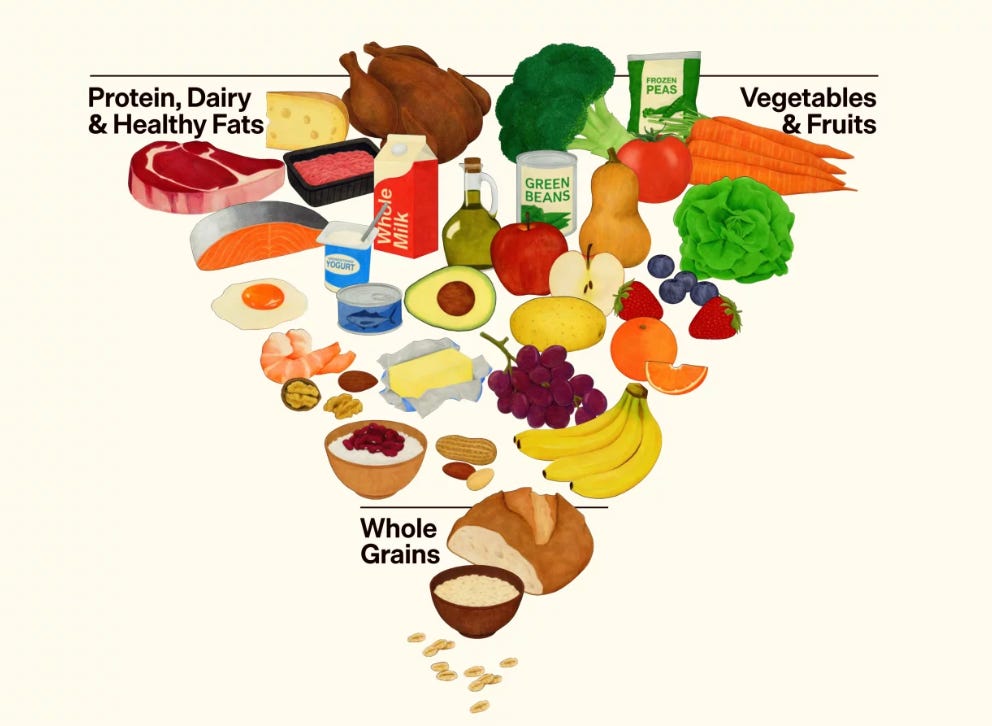
I’ll give credit where credit’s due (begrudgingly, but with the best intentions): ultra-processed foods are a public health problem. High intake is associated with obesity, metabolic disease, and poorer long-term outcomes in both adults and children. Reducing them is a widely supported goal across pediatrics and public health (AAP; DGAC; CDC).
Same with added sugar. Children do not need it. Limiting added sugar improves dental health, metabolic health, and appetite regulation over time. That’s not controversial. If the guidance stopped there, we’d largely be aligned.
But This is Where it Breaks From Evidence
Red Meat as a “Foundation” is Not Evidence-Based
The guidance’s elevation of red meat as a foundational protein source - particularly for children - directly contradicts decades of research.
Major medical organizations, including the American Heart Association (AHA) and contributors to the DGAC, consistently find that diets high in red meat and saturated fat are associated with increased risk of cardiovascular disease and certain cancers over time. This is why evidence-based guidance emphasizes variety: lean proteins, fish, legumes, nuts, seeds, and plant-based sources alongside moderate red meat intake.
Red meat is not inherently harmful, but it is not a nutritional centerpiece.

Saturated Fat: Not the Villain, Not the Hero
Calls to “end the war on saturated fat” make for good rhetoric, but they gloss over a large body of population-level data.
Yes, nutrition science evolves (all science does since that’s the cornerstone of, well, science). Yes, food matrices matter. But long-standing recommendations to limit saturated fat - especially in children - are grounded in observed associations between intake patterns and cardiovascular risk across lifespans (AHA; DGAC).
Industry Applause is a Signal - Not Proof, But Not Irrelevant
This guidance did not land quietly. Some of its most enthusiastic public praise came from beef and dairy trade organizations, including groups representing cattle and dairy producers, who openly welcomed the renewed emphasis on animal protein and full-fat dairy.
That does not mean the guidelines were “written by industry.” There is no evidence of that claim, and it’s not responsible to suggest it. But context matters.
When policy recommendations drift away from long-standing scientific consensus and align neatly with the commercial interests of specific sectors, that’s worth noting. Not as a conspiracy - but as a reminder that applause is not evidence.

Why Parents Should Still Follow Medical Consensus
Nutrition policy affects:
-
School lunch programs
-
Pediatric counseling
-
Federal nutrition assistance
-
How families interpret “healthy” at the grocery store
Parents should not be put in a position where they are asked to choose between their pediatrician and a Z-list politician. If guidance asks families to ignore decades of pediatric research in favor of a single political voice, that’s not courage. That’s a big, (saturated) fat red flag.
The Grounded Takeaway
Here’s what parents can safely anchor to - not because it’s trendy, but because it’s tested:
-
Prioritize whole, minimally processed foods
-
Limit added sugar
-
Offer a variety of protein sources - plant and animal
-
Balance matters more than extremes
-
Children are not adults, and their nutritional needs are not the same as ours

The Bigger Problem We’re Not Naming
The most concerning part of this moment isn’t any single food recommendation. It’s the growing expectation that families should weigh political personalities alongside pediatricians when making decisions about their children’s health. Like, when, how, and why did this become a thing?
Nutrition guidance should be shaped by people who spend their careers studying child development, metabolic health, and long-term outcomes - not by figures who frame skepticism of institutions as bravery while selectively embracing evidence that supports a predetermined narrative.
Children deserve food policy that is boring in the best way: careful, evidence-based, and resistant to ideological swings. They deserve guidance that evolves when the data evolves - not when the applause shifts. And parents deserve better than being told to trust louder voices over trained ones.
Final Word
We can challenge outdated guidance - and we should! - without replacing it with ideology. We can reject ultra-processed food without elevating single foods to savior status. And we can demand better public health leadership without pretending that conviction alone makes something true.
And when it comes to feeding children, trust should always be earned — through science, transparency, and humility. Not assumed.


